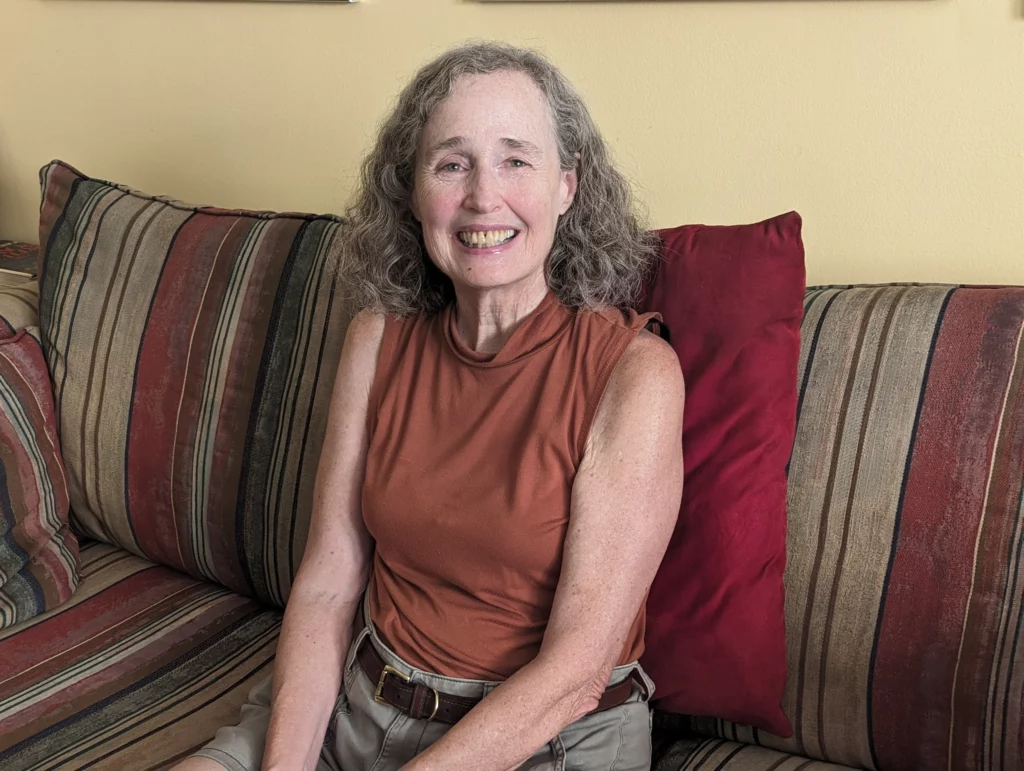
Madeline Talbott
Part 1 —
October 2, 2023
Interviewed by Judith McCray
Part 2 —
January 11, 0025
Interviewed by Judith McCray
Part 1 — 10/2/2023
This is Part 1 of Madeline Talbott’s oral history: Madeline Talbott lives in Chicago, Illinois, and was a staff member for ACORN from 1970 – 2008. She started as a field organizer in Pine Bluff, AK, then moved to Dallas, Houston, and Detroit before becoming the director of ACORN Chicago in 1983. In this interview, she discusses her early experiences organizing while a college student in Chelsea, MA, and how inspired she was by people’s willingness to invite her into her home, feed her, and share their problems and desired solutions. She discusses campaigns she worked on in Pine Bluff, AK; successful – and unsuccessful squatter’s strategies and campaigns in Detroit, then Chicago; bank, minimum/living wage and Fight for $15 fights and campaigns in Chicago; and her decision to leave ACORN and transition to the formation of Action Now. She discusses in detail and with great candor her experiences working with African Americans who inspired and taught her – Roosevelt Walker, Theo Epperson and Miss Mahalea Summerville. She openly talks about what she learned about herself, her implicit racial biases and her realizations of when how was wrong and had to learn that race, not class, is at the source of injustice in America. She also says that race must be at the forefront of any and all coalition building and organizing or racism will never be addressed or undone. This interview will be especially useful to anyone interested in the racial dynamics within ACORN and the struggle between using RACE or CLASS as the means to address injustice and build cross-racial coalitions.
Part 2 — 1/11/25
This is Part 2 of Madeline Talbott’s oral history: In this interview, Madeline Talbott focuses on her relationship with her husband, Keith Kelleher and family. She and Keith met in Detroit and worked collaboratively in ACORN, even as Keith moved over to union organizing for ACORN. They moved to Chicago in 1983 and had separate offices in the same building where they continued to work collaboratively and passionately in their work as organizers for the duration of her tenure with ACORN and Action Now. She also describes their decision to have children (2 daughters, and then raised a 3rd daughter when she was a teen) and how that impacted her leadership and growth. Having to learn to delegate as a mother with small children, she says, was the best decision she could make. Many of the most powerful organizers in the U.S. developed when she was forced to delegate. She also discusses the rampant sexism and sexual harassment that existed and was continuous amongst the male leadership and how she learned to navigate the tricky landscape that was pervasive. This interview of Madeline’s will be of great interest to anyone researching domestic relationships and decisions of organizers, and the challenges women faced during a time when sexism and sexual harassment were common place.